What would you do if you remembered something with extraordinary clarity, but the world around you insisted that it had never happened that way?
What if the discrepancy concerned not merely an obscure detail, but something you had purchased all your life, a television programme you had watched repeatedly, a song you had heard hundreds of times, or a movie scene that had once made a lasting impression on you?
When Past Memory and Current Reality No Longer Agree !!
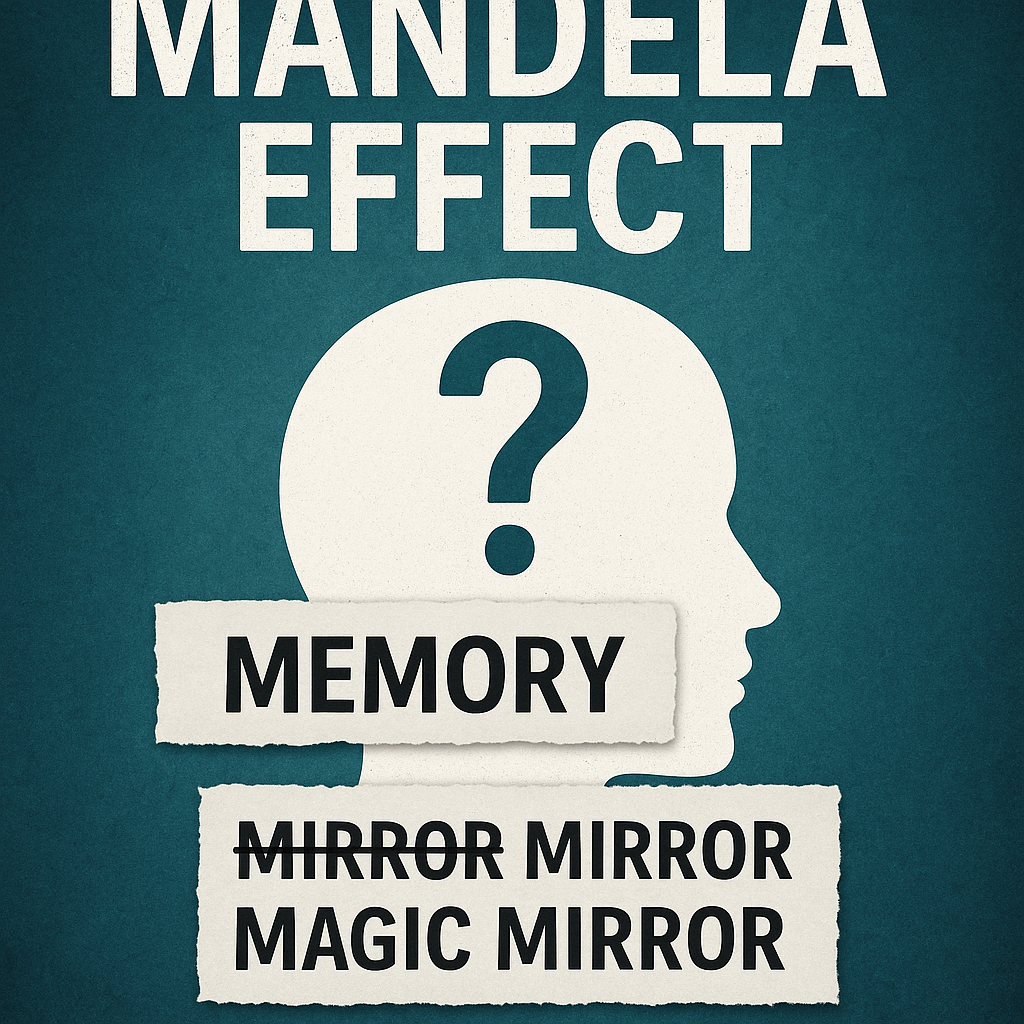
You remember things differently. Perhaps ‘Coca-Cola’ logo had a dash. Perhaps Samantha in Bewitched twitched just her nose-tip and not her mouth. Yet everyone else in the news media and the internet insisted that you had ‘false memories’ or that you are ‘misremembering things’. And what if entire continents were placed differently in the world map, or body parts placed in a different area of the body than what you knew in your childhood?
Let us call the past reality’s memory – Reality 1, and the current data as per internet and other people around – Reality 2 (where we are now).
Would you automatically conclude that your own memory (Reality 1) was wrong (doubt yourself)? Or would you investigate whether the discrepancy might have another explanation, such as you being in a false or alternate version of reality (Reality 2) or in other words, a new timeline?
My Investigation into My Memories of Mandela Effect
After examining 30 different Mandela Effects personally experienced with me, I concluded the following:
Not only was Reality 1 my original timeline, it also is the only one that actually makes some sense.
It becomes increasingly clear to me that this new reality all around is a false version that is incongruent with my actual lived experiences and with logic.
Read below for my personal evidence and what some others too seem to be saying.
1. Fruit of the Loom: The Cornucopia That Disappeared Right Before My Very Eyes
One of my strongest recollections concerns a Fruit of the Loom T-shirt I purchased for my then-husband in approximately March or April 2014.
We had recently moved into our home in Walthamstow. I remember choosing the T-shirt and giving it to him as a present. What made the occasion particularly memorable was the logo. I remember a cornucopia behind the fruit.
The cornucopia was not an incidental detail to me. I associated it with abundance, prosperity and the magical symbolism of an inexhaustible supply of fruit. In various mythological traditions, the horn of plenty represents the capacity to provide nourishment and material abundance. I explained this symbolism to my then-husband because I loved the symbol on that logo and he appreciated it then. He was happy to wear the T-shirt.
Approximately three months later, I remember him showing me the logo and expressing concern that the cornucopia had disappeared. He appeared to think that it might have faded during washing, leaving the fruit behind. I remember reassuring him that perhaps the symbolic abundance had already been ‘absorbed’, so to speak, and that the disappearance might even be interpreted positively.

This sequence is important to my recollection. I remember not only the cornucopia but also purchasing the garment, explaining its symbolism, and subsequently discussing its apparent disappearance.
I SAW THE REALITY CHANGING RIGHT BEFORE MY EYES
I watched it change quite literally, over that 3 month’s time window. Reality had been modified right in front of my very eyes and I had no idea that it had changed worldwide, and not just in my washing machine.
Years later since about 2023, I encountered the Mandela Effect discussion surrounding Fruit of the Loom online and many others. The currently accepted account is that the familiar logo did not contain a cornucopia, despite many people reporting that they remember one.
THE LOGIC OF THE CORNUCOPIA AND THE LOOM
I also found the symbolism of the logo particularly striking. A loom produces a pattern of fabric which emerges continually from the loom, while a cornucopia traditionally represents an abundant supply of fruit that keeps emerging and flowing out of the cornucopia. Logically speaking why would a logo for ‘Fruit of the Loom’ have only fruits with no reference to the symbolic ‘loom’ the place where the fruits overflow from? Fruits simply lying around make no sense by themselves.
HE WAS NOT WHO HE WAS
In 2024, when I asked my former husband about the T-shirt, he said he could not even remember it. That response added another dimension to the experience. I remembered a specific event involving both of us, yet the other person involved did not recall it. As if he was not the same person at all, the one who I knew before. More on this later with reference to Star Wars.
A part of the larger question worth investigating is: Why do some people retain particular recollections while others do not? Are some people from this alternate reality, but the rest of us from a different world (original reality) and do not really belong here?
2. Bewitched: Nose Twitch or a‘Mouth Twich’?
Another particularly compelling example concerns the television series Bewitched, starring Elizabeth Montgomery as Samantha Stephens as well as Nicole Kidman in the movie involving a reboot being forged. I remember Samantha’s signature magical gesture as a twitch of the nose, or as some say – a nose wiggle.
What makes this example interesting is that the nose is repeatedly emphasised in the programme’s dialogue and visual storytelling. When I now see the old Black and White episodes I can see the mouth moves, not the nose, but Darrin, her husband often refers to her ‘twitching the nose’ and also himself touches his own nose and moves its tip to demonstrate what he is talking about. When she twitches her mouth and not the nose, it makes no sense whatsover to refer to the nose throughout.
The gesture was sufficiently so iconic that in December 2023, I tried to reproduce it myself upon watching some YouTubers making videos and demonstrating how they successfully twitched their nose (the mouth did not move at all, just as the original reality was). However I could not reproduce the movement I remembered of the nose. It appears some people are genetically pre-disposed to twitch the nose (isolating just the nose tip, not the mouth with it) and some their ear tops. I am not one of them.
The 2005 film Bewitched, starring Nicole Kidman, provides another point of the current ‘version fail’.
I remember watching the film after my husband showed it to me in approximately 2011. I remember the casting storyline, in which the ability to reproduce Samantha’s nose twitch was important. The actor playing Darrin was looking for the female lead and was frustrated that none of the women appearing for auditions could properly twitch their nose, as some moved the mouth instead. He noticed just the nose of Isabelle (Nicole Kidman) through a bookshelf in the library incidentally while she sneezed and decided to cast her.
In October 2024, I watched the film again on Amazon Prime. I was shocked because the gesture appeared to involve the mouth rather than the distinctive nose movement I remembered. Now anyone could move the mouth – there would be absolutely no need to hunt for a special woman who could twitch the nose itself if she had to just move the mouth – right?
The casting narrative seemed inconsistent with the movement I was seeing. The film’s characters were looking for someone extraordinary, but in the new reality the star of the film’s so called ‘nose twitch’ seemed extremely ordinary to me.
Obviously the current reality (Reality 2) DOES NOT ADD UP.
The apparent flip-flop
More recently, I experienced something that made the question even more puzzling to me. On 27 October 2026, while watching Bewitched through a temporary Sony add-on on Amazon Prime, I thought I saw Samantha’s nose move in a scene involving her mother, Endora. I rewound the scene to show my son. But when I watched it again, the movement appeared to involve the mouth instead. I began questioning whether I had imagined the first version.
I have encountered accounts of what Mandela Effect communities call a flip-flop: an apparent change between versions, sometimes followed by a return to a previously encountered version.
There definitely is a version of the real world hidden behind the veil – and who knows we might even watch it emerge from behind the scenes one day. Like a hidden dimension. Now that would be truly Bewitching!
3. Britney Spears Videos: The Missing Microphone and Changed Skirt
My recollection of Britney Spears’s music video for Oops!… I Did It Again is another example I love because, I am a fan of this music video and song. I remember watching the video on MTV and Channel V while living in Mumbai in my youth when I was transitioning from 19 to early 20s. In my recollection, Britney wore a red outfit and performed with a microphone incorporated into a headset. I remember the microphone in front of her mouth as part of the futuristic and sleek styling.
Look at this reddit thread screenshot showing the dolls of Brittney and the impressionists who imitated her. Why do they all remember that microphone headset?

Years later, when I watched the official video on YouTube, I was surprised not to see the microphone I remembered. What particularly caught my attention was a movement of her hand near her mouth. To me, the gesture looked as though she were adjusting or checking a microphone that was no longer visible. By then I had even purchased a similar microphone for a parody video for animal rights, based on this original video that I had intended to make before encountering the discrepancy. Apparently I did not need to!
Look at the original song yourself in YouTube and stop at 2.43 to see her hand move to adjust the invisible microphone.

Another striking change was the famous plaid and pleated skirt of Baby One More Time video changing to plain black skirts without pleats (just little wrap-round skirts), worn by her and the backup dancers, (somewhat blurry looking too as if ‘photoshopped’, if I may add).

And look at what other observers of ME are saying – Brittney Spears herself wore the plaid skirt with pleats to remember her own outfit in later years!!

So did an AI generate a new version of reality and copied content from the past – in the process of which some items or components digitally ‘fell out’ or were altered by mistake? As we all know by now, AI can generate a of humungous amount of videos, music, art, books, films, etc instantly – so it is a plausible explanation.
Is this reality AI generated to some extent? A computer simulation!! (And perhaps they did a somewhat sloppy job, as usual).
4. Cartoons: Pikachu and Curious George: Memories Shared with My Son
Pikachu, the Pokémon character as I remember had a black zigzag or tip at the end of Pikachu’s tail. I also remember deciding against purchasing a T-shirt for my kid at Chelmsford around 2021, because the dark shape looked too prominent on the front of that t-shirt. My son also remembers the black tip on Pikachu’s tail and says that he actually liked it and would have worn the t-shirt if I had not kept it away.
Other people also remember the black tip clearly:

Another example concerns Curious George. My son remembers George having a tail, and he recalls the character using it to pick things up (an apple orchard and picking fruit for example). I also remember George in a fruit-juicing factory and my concern that his tail might become caught in a conveyor belt in 2014.
Logically speaking a light brown monkey would be expected to have a tail normally. Fortunately some others agree too.

So why did a new reality fail to apply this basic logic? Was it an AI mistake? Curiouser and curiouser!!
Looney Toons, a cartoon I once saw as a younger kid with my little sister, was a play on words – looney and therefore oo in toons, as in cartoons. It makes no sense to call it Tunes because these were cartoons and not just musical tunes.
I find the new version of this reality a bit hard to digest logically speaking. Do you?
5. Music: Of the late 90s MTV Videos
A substantial group of my recollections concerns music from the late 1990s and early 2000s, particularly songs and videos I remember encountering while living in Mumbai and growing up from teens to early 20s.
- I’m a Barbie Girl by Aqua. This definitely was – I’m a Barbie girl, in a barbie world. Why would it be ‘In The Barbie world’ if there is no specific place called The Barbie World. It is ‘a’ Barbie world (hypothetical or imaginary).
- Sweet Dreams by Eurythmics. This definetely sounded like Sweet Dreams are Made of These. Describing many different type of people – some wanting to use you, some wanting to get used by you, etc…These, not this.
- Who Will Save Your Soul by Jewel definitely did not have Souls in plural. It was about a cheating ex – Who will save your soul, of all the lies you have told boy.
- Gangsta’s Paradise by Coolio. This definitely went – ‘Standing all my life living in a gangsta’s paradise’ followed by in the 2nd half ‘standing all our lives.’ It was never ‘standing all their loves’ as the song was sung in first person.
- Another Brick in the Wall by Pink Floyd. All in all its just another brick in the wall. Not ‘you’re’ just another brick in the wall.
- Wonderwall by Oasis. Today is gonna be the day that I’m gonna….is what I remember. Not ‘they’re gonna throw it back to you’.
- How Deep Is Your Love by Take That. I really need to know – how deep is your love (a desperate need to know). It was not ‘I really mean to learn’.
- We Are the Champions by Queen. Ended with ‘of the world’. I remember that in 2022 when I went to attend a school event for my son at Chelmsford, where he won a gold medal for singing in the choir, this song played in the background and I expected – of the world in the end, but abruptly the song ended.
6. Movies: Luke, Scotty and Shahenshah
My ex husband showed me two of his most favourite films in 2016-2017 and showed me his favourite dialogues within these two films. In Star Wars – ‘Luke I am your father’, he explained was an iconic dialogue, as I had never seen this film till then. But later he said it was ‘No, I am your father.’ This makes me wonder – is he even the same person? Because this is literally his favourite scene or dialogue in his favourite film of all times. So this is a Flip Flop right below. So confusing!!


The second film Star Trek in which he loved the dialogue ‘Beam me up Scotty.’ but sadly it has changed to ‘Scotty Beam Us Up’ and he does not now remember the original one. How weird to forget your own favourite lines of your favourite films!! And funnily other movies remember the world of the original reality timeline such as the one below (Man Who Knew Too Little).

In my childhood my sister loved watching this film Shahenshah with Amitabh Bachhan in it saying ‘Rishtey mein to hum tumhare baap lagte hain.’ It was not ‘hote hain’. (Or has this changed again to Lagte Hain – a flip-flop has happened already? Because upto recently I saw that there was a Mandela Effect recorded and it was turned to ‘hote hain’.)

7. Indian Brand Logos: Actual memories
As I lived in India first until 2012, I only go into logos and brands I noticed there and not the American ones.
– Thumbs Up: A cola my friends loved in college canteen was definitely not called Thums Up.
– Coca-Cola: It definitely had a wavy dash in the middle and not just a little square up there.
– Kit-Kat: I remember an advertisement ‘Have a break, have a kit-kat’ with a break sound and a hyhen appearing with the words Kit-Kat as if one part was breaking and falling sideways.
– Maggie: Instant noodles my little sister loved was Maggie first. In UK I noticed Maggi
– Cup-a-noodles: A cup of noodles shortened as cup-a-noodles was what I remember seeing in some select shops, and later in a movie scene in Sex and the City, I remember the actor narrate ‘Cuppa noodles’ but the visual was of Cup Noodles, in 2023 when I saw it. Reality had been changed.

8. National Game of India?
In my childhood in schools I remember learning in primary school that Hockey is our national game which was well accepted, and in later years in secondary also that Kabaddi is the national sport also played in Olympics. None of these are true in this version of reality.
9. Art: Mona Lisa ‘Smile’
The strange smile in the portrait by Da Vinci was confusing in the original version of Reality 1. It was not a cheerful smile. I remember that in my Psychology degree training in 1990s, my professor in Mithibai College Mumbai University, told us about an experiment where researchers asked two groups if they thought Mona Lisa was smiling and happy, or not happy (because of her portrait being famous as cryptic smile). The experiment seemed to indicate that people interpreted it subjectively depending on their own internal state at the time.
Clearly the smile was something different from the present version of reality where it is a bit brighter. Now new research in this Reality 2 we are in, seems to indicate that more than 80% of viewers interpret is as a happy smile. How bizzarre!

The question is why would Mona Lisa be so enigmatic and famous for its smile if the smile were a normal happy one to begin with. The very logic is failing in this odd new reality.
Remnants of Reality 1, can be seen however in a Wizards of Waverly Place episode in which the smile was made happier with magic, because it was not quite happy to begin with.
10. Literature: Mirror Mirror
I may not remember Bernstein Bears as I am not American and did not get to read that book, but definitely I remember Mirror Mirror on the wall. It was not Magic Mirror on the wall as the current reality states.
Remnants of this Mandela Effect are left behind with Julia Robert’s movie by the name Mirror Mirror of a Snow White tale retelling, and also several other scenes in movies with other stars too saying Mirror Mirror on the wall. Why would they name it that if the truth was Magic Mirror?
11. Biology: The Human Anatomy
My mother was a heart nurse in a hospital when I was a kid. Even now she remembers that the heart was more to the left than the diagram of the new reality, and kidneys were not so high up. Infact in a kidney ultrasound in Chemsford in 2023 I was taken aback when the male nurse went up to my upper chest – I was about to complain when he explained he was looking for my kidneys – up there annoyingly.
And when did eye sockets have some extra bones behind the eye hollows?

Why does the rib cage diagram seem so spiky instead of well rounded in the lower part where spikey floating bones are shown? This is bizarre.

Our biology has been changed – in this new reality or timeline – and we make no bones about it.
12. Geography: The Right Side Shift
Panama canal joined North and South America that were more aligned, above and below it. When did South America move more to the right?
Similarly Sri Lanka moved more to the right. As an Indian student living in India until my early 30s after being born there, I can assure you that Sri Lanka was below the tip of Indian peninsula (very slightly off centre to the right) with a few little dots shown on our map between our country and Sri Lanka. Not above the southmost tip of our country to the SE corner.

And New Zealand moved more to the South East side of Australia. These are big changes to the original reality where I am from.

13. History: Dead or Not
I never remembered Neil Armstrong dying in 2012. That was the year my son was born and the year I was made to move into the UK from India – a very eventful year that changed my life forever. So a huge thing like Neil Armstrong dying would have not been forgotten by me.
And my mother was surprised that Nelson Mandela died in 2014 as she says it happened much earlier than that. This is where the name of Mandela Effect comes from. She clearly is from the original reality or timeline.
All this extensive analysis leaves me with some questions:
What sort of a bizarre timeline or alternate reality have I landed myself into?
How was it manipulated?
And most importantly who has been responsible for putting me (or you if you are like me) in this simulation?
Or is it just ME?
These are important questions we all should be asking – if we feel that we do not belong here.
I do not allow others to deceive or gaslight me into thinking that my memories are at fault. Because mine are certainly reliable in this context. What about yours?